When it comes to male fertility, you might be forgiven for thinking that sperm count is the be-all and end-all. Now, it’s fair to say that getting pregnant is a bit of a numbers game, but that doesn’t mean that your sperm count is the sole predictor of how likely you are to conceive naturally – there’s a bit more to it than that. Here we’ll explain why sperm count is only part of the equation and explain what Progressive Motile Sperm Count (PMSC) measures.
What is a normal sperm count?
Sperm count is one of the sperm health parameters many of us are familiar with. Whilst often used interchangeably with sperm concentration, sperm count tends to refer to the total number of spermatozoa produced per ejaculation, concentration refers to the sperm count per millilitre of semen. You can check your sperm concentration at home in a few minutes.
On average a normal sperm count is over 15 million sperm cells per millilitre. If you have less than that, it’s classed as Oligospermia, which basically means low sperm count. If you are struggling with Oligospermia there is a chance that it may be harder to conceive or that you might require assisted fertility treatments. There can be a few different causes of low sperm count – but often it can be improved through lifestyle changes or with medical interventions.
If you have next to no sperm cells in your ejaculate, this is known as Azoospermia. Azoospermia is harder to turn around and is usually due to a previous medical condition or genetic disorder.
But that’s not the whole story…
If you were playing a football match, would you rather have 11 men who were slow and had lots of injuries, or 10 men who were incredibly fit and at the top of their game? Personally, we’d go for fewer men who were performing highly! And that analogy can help you understand why sperm count is only one factor in your ability to conceive.
For sperm to reach and fertilise the egg, they have to move. The sperm cell’s ability to move (at pace and in the right direction!) is known as sperm motility. Now, you could have 25 million sperm cells per millilitre and be getting top points on sperm count. But if most of those cells are static they’re not going to help you make a baby.
Progressive vs non-progressive motility
Even within motility, it’s important to differentiate between progressive and non-progressive. Progressive motility is what you want to see. It’s the sperm cell’s capability to swim mostly in a straight line or in very large circles – and a good indicator that it will be able to make it up the vaginal canal to fertilise the egg. Speed-wise, you want to see sperm cells moving around 25 micrometres per second.
Non-progressive motility is when the sperm cells are moving but very slowly and not in a straight line – or sometimes in very small circles.
Whilst not every sperm cell you have will be giving Usain Bolt levels of speed, WHO guidelines recommend that at least 32% of sperm cells in an ejaculate should have good progressive motility, else it could cause issues with making a baby.
Progressive motility describes the proportion of sperm moving forward. PMSC combines that proportion with sperm concentration and semen volume.
What is Progressive Motile Sperm Count?
Progressive Motile Sperm Count (PMSC) estimates the number of sperm moving forward in the sample. Here’s how to calculate it.
(Sperm count per millilitre x semen volume in millilitres x percentage of progressively motile sperm) ÷ 100 = Progressive Motile Sperm Count.
For example, if you had 35 million sperm cells/mL of semen, you were ejaculating 2mL of semen and 32% of those sperm cells were showing progressive motility, the equation would look like this.
35 million sperm/mL x 2mL of semen x 32 (percent) progressive motility ÷ 100 = A PMSC of 22.4 Million
How do you interpret PMSC?
Read PMSC alongside the other semen measurements. The examples below show how different results can produce similar counts.
A sample with lower sperm concentration can still have a higher PMSC if a greater proportion of sperm are moving forward. For example:
10 million sperm/mL x 3mL of semen x 55 (percent) progressive motility ÷ 100 = 16.5 million PMSC
A higher sperm concentration can also produce a similar PMSC even when progressive motility is lower. For example:
30 million sperm/mL x 3mL of semen x 20 (percent) progressive motility ÷ 100 = 18 million PMSC
It’s important to do everything you can to optimise both your sperm count and sperm motility – and both can be impacted by unhealthy lifestyle habits like smoking, stress, excessive drinking and a lack of nutrients and exercise. You can learn more about improving your overall sperm health here.
How can I find out my Progressive Motile Sperm Count?
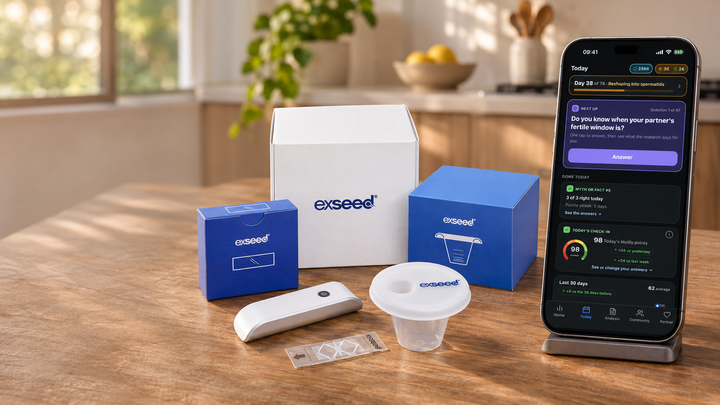
Our ExSeed at-home sperm tests can quantify everything needed to find out your Progressive Motile Sperm Count. You produce a sample into the cup provided and record the semen volume into the app yourself.
Then using the ExSeed device and your smartphone you take a moving image of your sperm sample. Our in-app technology will then count the sperm cells and assess their progressive motility. The app uses these measurements and the recorded semen volume to calculate your Progressive Motile Sperm Count (PMSC).
Click this link to find out more about our fertility test today.