-
Home Sperm Test: See Your Fertility Score in 15 Minutes
Regular price From £94.99 GBPRegular priceUnit price per£84.99 GBPSale price From £94.99 GBP -
ExSeed Home Sperm Test Kit (2 tests)
Regular price £94.99 GBPRegular priceUnit price per£84.99 GBPSale price £94.99 GBP -
ExSeed Refill Kit
Regular price From £41.99 GBPRegular priceUnit price per£31.99 GBPSale price From £41.99 GBP -
ExSeed Home Sperm Test Kit (5 tests)
Regular price £149.99 GBPRegular priceUnit price per£189.99 GBPSale price £149.99 GBPSale -
ExSeed Home Sperm Test Kit (10 tests)
Regular price £219.99 GBPRegular priceUnit price per£364.99 GBPSale price £219.99 GBPSale -
Male Fertility + Hormone Check
Regular price £114.99 GBPRegular priceUnit price per


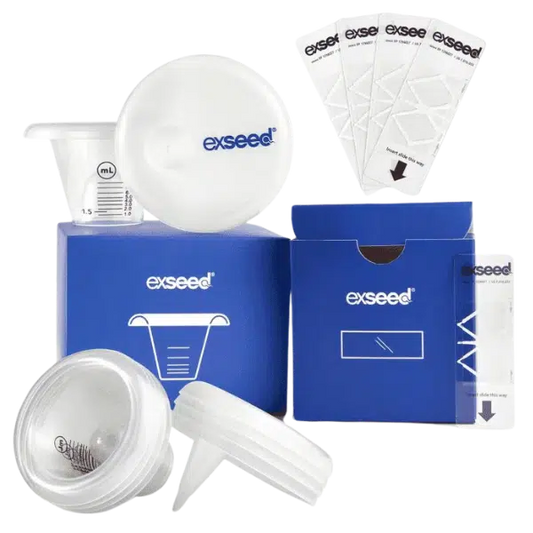


What does a sperm concentration test kit measure?
Most home sperm concentration test kits use a lateral flow strip based on the SP-10 protein. They tell you whether your sperm concentration is above or below a threshold — typically 15 million sperm per mL, the WHO reference value. That is useful as a starting point, but it is incomplete.
Sperm concentration alone does not tell the full story. A sample can have adequate concentration but poor motility, meaning the sperm present cannot swim effectively enough to reach an egg. This is why fertility clinicians use Total Motile Sperm Count (TMSC) — the combined measure of how many sperm are present and how many are actively moving in the right direction.
ExSeed measures all four clinically relevant parameters:
Sperm concentration: Sperm per mL of ejaculate (WHO reference: ≥15 million/mL)
Sperm motility : Percentage of sperm showing progressive movement (WHO reference: ≥32%)
Semen volume: Total ejaculate volume (WHO reference: ≥1.5 mL)
Total Motile Sperm Count (TMSC): The number that combines all three into a single fertility indicator

 | Send Away Tests | |
|---|---|---|
| Sperm concentration | Exact count (million/mL) | Pass/fail threshold |
| Sperm motility | Progressive motility % | Not measured |
| Sperm volume | Measured | Not measured |
| Total Motile Sperm Count | Full TMSC readout | Not calculated |
| Result format | Numerical score with WHO comparison | Pass / Fail |
| Technology | Smartphone microscopy | Lateral flow immunoassay |
| CE-marked | Yes | Varies by brand |
WHO reference values for sperm concentration
The World Health Organisation (WHO) 5th Edition reference values are used by clinics and fertility specialists worldwide to interpret semen analysis results:
- Sperm concentration: 15 million sperm per mL or above
- Progressive motility: 32% or above
- Semen volume: 1.5 mL or above
- Total Motile Sperm Count: typically 9–10 million or above as a general clinical guide
ExSeed reports your results against these WHO values so you understand where you stand without needing a clinic appointment. If your results fall below these thresholds, the app will explain what that means and recommend whether to speak with a GP or fertility specialist.
How to use a sperm concentration test kit at home
- Abstain for 2–5 days before testing — this is standard protocol for semen analysis and ensures results are representative.
- Collect your sample using the sterile container included in the kit.
- Attach the smartphone adapter to your phone camera.
- Follow the app instructions — the ExSeed app walks you through each step.
- View your results — concentration, motility, volume, and TMSC appear within 15 minutes.
- Track over time — sperm quality fluctuates. Testing twice, 3 months apart, gives a more reliable picture.

When to retest
Sperm production cycles take approximately 72–90 days. A single sperm concentration test kit result is a snapshot, not a definitive diagnosis. Factors such as recent illness, heat exposure, alcohol, and stress can temporarily affect sperm quality.
ExSeed's 2-test and 5-test kits are designed for this reason. Test once to establish a baseline. Make lifestyle changes. Retest after 3 months to measure the impact. This is the approach fertility specialists recommend before pursuing clinical investigation.