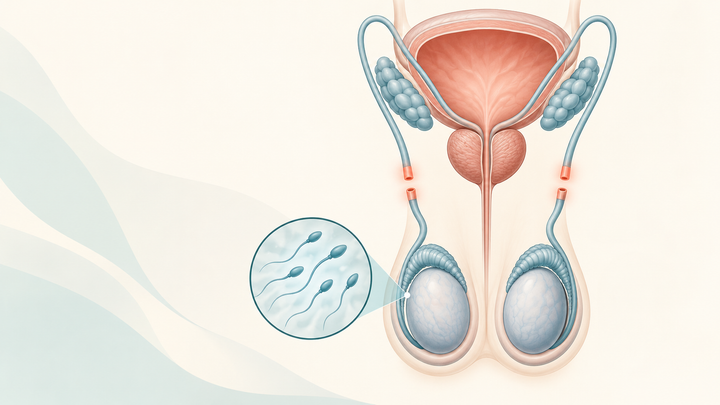
Trying for a baby can bring plenty of questions. Are we getting the timing right? Should we change anything? When should we ask for help?
Questions about sperm health belong in that conversation too. The NHS estimates that around one in seven couples may have difficulty conceiving, and fertility problems can affect either partner.
National Fertility Awareness Week runs from 2–6 November 2026, led by Fertility Action. It is an opportunity to make male fertility easier to discuss and help people understand their next steps.
Can you tell whether your sperm are healthy?
Feeling healthy does not give you a sperm count. The NHS explains that low sperm count is usually discovered through fertility testing.
If you have been wondering whether the appearance of semen offers useful clues, our guide explains what you can and cannot tell by looking at sperm.
Testing can provide more information, but understanding the result matters just as much as getting it.
What does a semen analysis measure?
A clinical semen analysis examines several features of a sample, including:
- Sperm concentration: how many sperm are present per millilitre.
- Motility: how many sperm move and how they move.
- Morphology: sperm shape and structure.
- Semen volume: the amount of fluid in the sample.
These are among the measurements listed by North West London Pathology’s NHS semen analysis service.
Home tests vary in what they assess. Before choosing one, check which measurements it provides and what follow-up support is available. Our guide to what to look for when buying a home sperm test explains the questions to ask.
What can your results tell you?
A semen analysis helps investigate fertility, but it cannot provide a simple guarantee about pregnancy.
University College London Hospitals explains that samples from the same man can vary considerably. Results outside reference ranges do not necessarily mean someone is infertile, and the measurements need to be considered together.
Your clinician may recommend another test to confirm the findings. For more context, read our explanation of why sperm test results can differ each time.
Try to avoid treating a single number as a verdict. Ask what the result means in your circumstances and whether further investigation would help.
Practical steps that may support sperm health
If you have a low sperm count, the NHS recommends several changes that may help:
- Stop smoking if you smoke.
- Reduce alcohol intake and keep within the recommended maximum of 14 units a week, spread over at least three days.
- Lose weight if you are overweight.
- Avoid recreational drugs, including anabolic steroids.
- Reduce exposure to workplace chemicals such as pesticides, solvents and certain heavy metals.
These steps do not guarantee a particular result. They are practical changes to discuss alongside testing and medical advice.
You can also read our article on alcohol, sperm quality and male fertility for a closer look at that topic.
When should you speak to a GP?
The NHS advises seeing a GP if you have not conceived after a year of trying. Seek advice sooner if the person trying to become pregnant is aged 36 or over, or either partner already knows of a possible fertility problem.
Both partners should be involved in investigations where relevant. The NHS guidance on low sperm count explains that a GP can arrange tests to check both partners’ fertility.
A home test should not delay that appointment.
Making the conversation easier
You do not need a perfect opening line to talk about fertility. Something practical can be enough:
“Could we talk about what we both want to check, and when we should ask for advice?”
Give each other room to explain what feels difficult. One person may want information immediately; another may need time before discussing testing.
Our guide to talking to your partner about a fertility test offers ways to start.
If you need support beyond the medical appointment, Fertility Action provides fertility information, guidance and support.
Take the next step
This National Fertility Awareness Week, make space for sperm health in the conversation. That could mean talking to your partner, booking a GP appointment or learning what testing involves.
Explore ExSeed’s home sperm testing options, check what each test measures and seek medical advice if you have concerns.
This article provides general information and does not replace individual medical advice.