Sperm is not automatically “stronger” the second time you ejaculate. A second ejaculation soon after the first usually contains less semen. However, some studies have found better sperm movement or less sperm DNA damage in a second sample, particularly in men with abnormal semen results. This does not prove that having sex twice in quick succession improves everyone’s chances of pregnancy. Systematic review of second ejaculates.
To understand why, it helps to separate three things: how much fluid you ejaculate, how many sperm it contains and how well those sperm function.
Sperm and semen: what is the difference?
Sperm are the reproductive cells that can fertilise an egg. Semen is the fluid released during ejaculation that carries those cells.
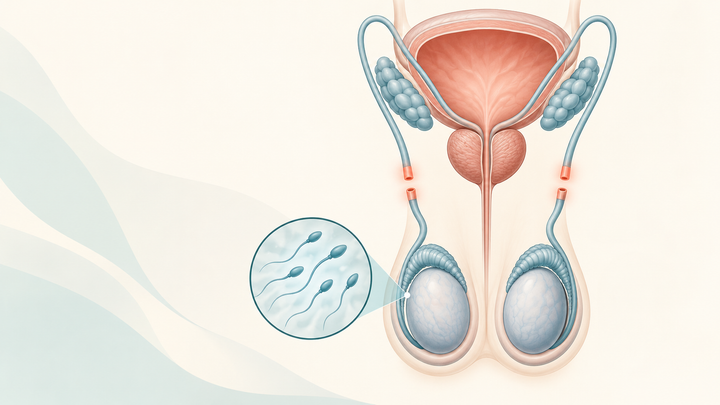
Your testicles make sperm. A coiled tube behind each testicle, called the epididymis, allows sperm to mature and stores them before ejaculation. Most of the fluid in semen comes from the seminal vesicles and prostate gland. Cleveland Clinic: semen.
This means a larger ejaculation does not necessarily contain healthier sperm.
When assessing semen, a laboratory looks at several separate measures:
| Measure | What it means |
|---|---|
| Semen volume | How much fluid you ejaculate |
| Sperm concentration | How many sperm are in each millilitre |
| Total sperm count | How many sperm are in the whole ejaculation |
| Motility | How well the sperm move |
| Morphology | The shape of the sperm |
These measures provide useful information, but no single result can establish whether someone can or cannot conceive. MedlinePlus: semen analysis.
Is round 2 sperm strong?
Second-round semen can contain sperm capable of fertilising an egg. But “strong sperm” is not a medical measurement, and a second ejaculation is not consistently better than the first.
A 2022 systematic review examined second ejaculates collected within four hours of the first. It found that:
- Semen volume was lower in the second sample.
- In men with abnormal sperm measures, the second sample showed improvements in sperm concentration and movement.
- Sperm DNA fragmentation — breaks in sperm DNA — was also lower in this group.
The benefits were not consistent across all groups. The findings mainly concern laboratory measurements, so they should not be interpreted as a guarantee of better natural pregnancy chances. Read the systematic review.
A smaller second ejaculation therefore does not automatically mean poorer-quality sperm. Equally, it should not be assumed to contain better-quality sperm.
How long do balls take to refill?
There is no single “refill time”. Your testicles produce sperm continuously, rather than emptying completely and starting again after each ejaculation.
Developing new sperm takes about three months. But sperm develop at different stages, so you do not need to wait three months between ejaculations or attempts to conceive. Your Fertility: healthy sperm.
It also helps to distinguish sperm production from semen volume. Most semen is fluid made by glands outside the testicles. The amount you release can be lower when ejaculations happen close together. Cleveland Clinic: semen.
Claims that everyone fully “refills” after exactly 24, 48 or 72 hours oversimplify the process. Sperm development, stored sperm and the amount of fluid ejaculated are different things.
Does saving up sperm improve fertility?
Waiting longer can increase semen volume and sperm concentration, but that does not necessarily improve sperm quality.
A 2024 meta-analysis found that longer abstinence was associated with more semen and a higher sperm concentration, alongside greater sperm DNA fragmentation. This illustrates why “more sperm” and “better sperm” are not interchangeable. Research on abstinence and sperm measures.
For people trying to conceive naturally, the American Society for Reproductive Medicine advises against limiting intercourse to save up sperm. Daily ejaculation is generally compatible with normal sperm concentration and movement in men with normal semen quality. ASRM fertility guidance.
How often should you have sex when trying for a baby?
A straightforward approach is to have sex every two to three days throughout the cycle. This is the NHS definition of regular intercourse when trying to conceive. NHS: infertility diagnosis.
If you are tracking ovulation, ASRM recommends intercourse every one to two days during the fertile window: the six-day interval ending on ovulation day. More frequent intercourse is not associated with lower chances of conception. ASRM fertility guidance.
There is no established need to have sex twice in one session. Choose a frequency that feels manageable, and follow individual advice if you are receiving fertility treatment.
Why do semen tests require abstinence?
Preparing for a semen test is different from trying to conceive.
Laboratories commonly request two to seven days without ejaculation before collecting a sample. This helps make the results interpretable under specified collection conditions. Follow your own laboratory’s instructions, as requirements vary. MedlinePlus: semen analysis.
For example, University College London Hospitals requests three to five days of abstinence. This testing instruction does not mean everyone should wait that long between attempts to conceive. UCLH sample collection guidance.
When should you seek fertility advice?
Speak to your GP if pregnancy has not happened after a year of regular unprotected sex. Seek advice sooner if the person trying to become pregnant is aged 36 or over, or either partner has a known or suspected fertility problem. NHS: when to get help.
If you are concerned about sperm quality, a semen analysis is more useful than judging the size of an ejaculation or whether it happened during the first or second round.