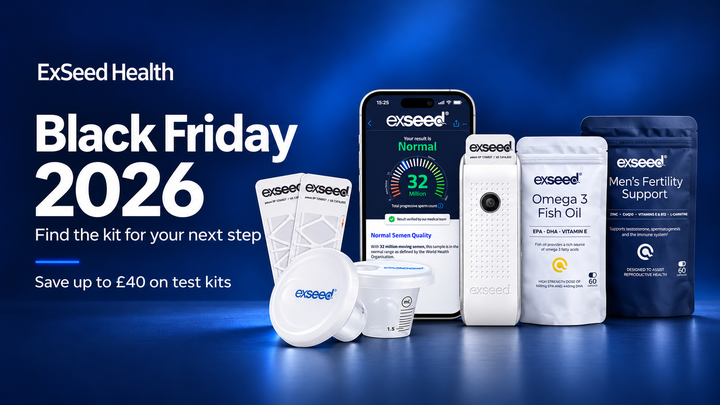
Disclosure. Motily has a commercial relationship with ExSeed. It features ExSeed test kits in its app and offers ExSeed kits, refills and supplements on its website. Motily earns a commission or margin on ExSeed products bought through it.
After your first home sperm test, it can be hard to remember what you meant to change by the time you test again. I built Motily for that stretch. It’s a free-to-download iPhone app that gives you a short daily check-in and a way to see how consistently you’ve kept up the habits you chose.
What you do in the app
- Check in each day. In about two minutes, you can log habits such as sleep, exercise, alcohol and nicotine. Your check-ins build a streak and a Motily score based on the habits you log.
- Follow a 74-day programme. Four phases give the time between tests some structure. The programme takes its name from a widely cited estimate of how long sperm development takes. A small study found that the timing varies considerably between men [2, 3].
- Record your first ExSeed result. You can enter semen volume, sperm concentration and progressive motility. You can also enter the motile sperm count shown on your test report. WHO reference values come from standardised laboratory semen analyses [6]. If a home result is low or you’re unsure how to read it, speak to your GP.
How it fits alongside your ExSeed kit
- Take your first ExSeed test and follow the kit instructions. If it reports no sperm or a very low count, contact your GP promptly. NICE recommends a repeat clinical semen analysis as soon as possible when those findings are detected [1].
- Add your first result to Motily and start the daily check-ins if you’d like to track your habits.
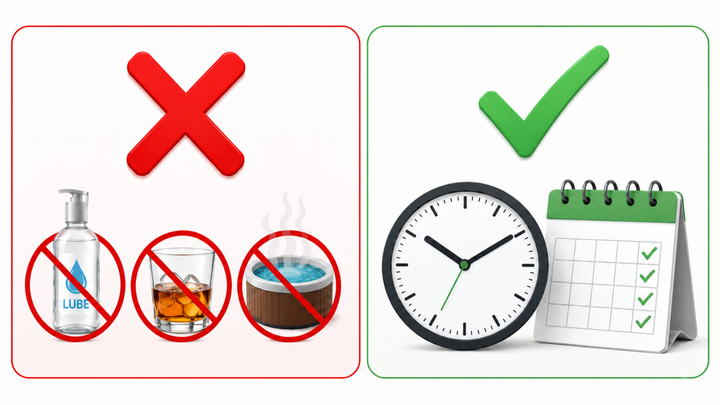
- If you’re planning a home retest to compare results over time, around three months is a practical point to do it. Follow any advice from your GP. Use ExSeed’s collection instructions and aim to match the interval without ejaculating before each sample [8].
- Look at both results together. Sperm concentration can vary considerably from one sample to the next [7]. Ask your GP about results that are low or hard to interpret.
When to speak to your GP
Speak to your GP if you and your partner haven’t conceived after a year of trying. Go sooner if your partner is 36 or over or either of you knows there may be a fertility problem [4]. Motily tracks habits. A GP can help you interpret your results and decide what to do next.
To try the app, search for Motily on the App Store or visit motily.app.
Bosco Foulsham is the founder of Motily, a free-to-download app for men who are trying for a baby or planning ahead. He is not a doctor.
Sources
- NICE. Fertility problems: assessment and treatment (NG257), 2026, recommendations 1.17.3 and 1.17.4. https://www.nice.org.uk/guidance/NG257/chapter/investigation-of-fertility-problems-and-management-strategies
- Heller CG, Clermont Y. Recent Progress in Hormone Research, 1964; 20: 545 to 575 (PMID 14285045). The 74-day figure as cited in Neto FTL et al. Seminars in Cell & Developmental Biology, 2016. https://doi.org/10.1016/j.semcdb.2016.04.009
- Misell LM et al. Journal of Urology, 2006 (11 men; mean 64 days, range 42 to 76). https://www.qxmd.com/r/16406920
- NHS. Infertility (when to see a GP; smoking, alcohol, weight). https://www.nhs.uk/conditions/infertility/
- WHO laboratory manual for the examination and processing of human semen, 6th edition, 2021. https://who.int/publications/i/item/9789240030787
- Alvarez C et al. Human Reproduction, 2003; 18(10): 2082 to 2088. https://doi.org/10.1093/humrep/deg430
- ExSeed Health. How to collect a semen sample for ExSeed home testing. https://www.exseedhealth.com/how-to-collect-a-semen-sample-for-exseed-home-testing/